3 Gestalt therapy as relational medicine in practice
In a large-scale Delphi study, Fogarty et al. (2016) surveyed 63 leading international Gestalt experts across several rounds to investigate what constitutes the specific identity of Gestalt therapy within the field of psychotherapy and to what extent its therapeutic approach can be distinguished from other schools of thought. This consensus-building process formed the basis for the subsequently developed and validated Gestalt Therapy Fidelity Scale (GTFS; Fogarty et al., 2020).
The study identifies eight key concepts of Gestalt therapy, although the authors themselves emphasise that this breakdown appears artificial, as several concepts are at work simultaneously in any given clinical moment (Fogarty et al., 2016, p. 34).
“GT is a dynamic, integrative, embodied approach that addresses human existence as a fundamentally relational modality […] anchored in a deeply dialogic relationship […].” (Fogarty et al., 2020, p. 495, abridged)Footnote 1 Trans. M.P. (abridged): Gestalt therapy is a dynamic, integrative and embodied approach that understands human existence as fundamentally relational: the self is always embedded in a dynamic organism-environment field. […]
The primary core concept of Gestalt therapy is the development of awareness: noticing what a person does otherwise unnoticed, how they perceive , how they interpret, and how they ascribe meaning to their experience. This overarching primary goal is complemented by seven further key concepts. Two of these form the underlying framework for the following tools: dialogical relationship-building and working in the immediate ’here and now’. They are not merely techniques, but describe an overarching fundamental approach.
Yontef (1998, p. 88, cited in Votsmeier-Röhr & Wulf, 2024, p. 180) identified the characteristics of this dialogical attitude as presence, encompassment, affirmation and commitment to dialogue in the service of the ‘in-between’, thereby naming almost the same aspects that the international consensus later confirmed (Fogarty et al., 2016, p. 36). These same core competencies are independently confirmed by an empirical study from the German-speaking integrative training context, which derives ‘awareness’, ‘dialogical and phenomenological approaches’ and ‘experience-orientation in the here and now’ from the specialist literature and tests them on 205 practitioners (Grillmeier-Rehder, 2020, pp. 51 ff., 102).
The remaining five key concepts (phenomenological approach, working with embodiment, field sensitivity, contact processes and the experimental attitude) are summarised in three guiding questions, which provide the structure for this chapter.
What is being worked with: body and feeling (Chapter 3.1)
Where does the encounter take place: field and contact boundary (Chapter 3.2)
How does it unfold: the concrete execution (Chapter 3.3)
They relate the five dimensions of embodied experience (Chapter 2.3) to clinical practice (see Figure 2). In therapy, these dimensions never operate in isolation, but always simultaneously. The division into three subchapters serves solely for the purposes of presentation.
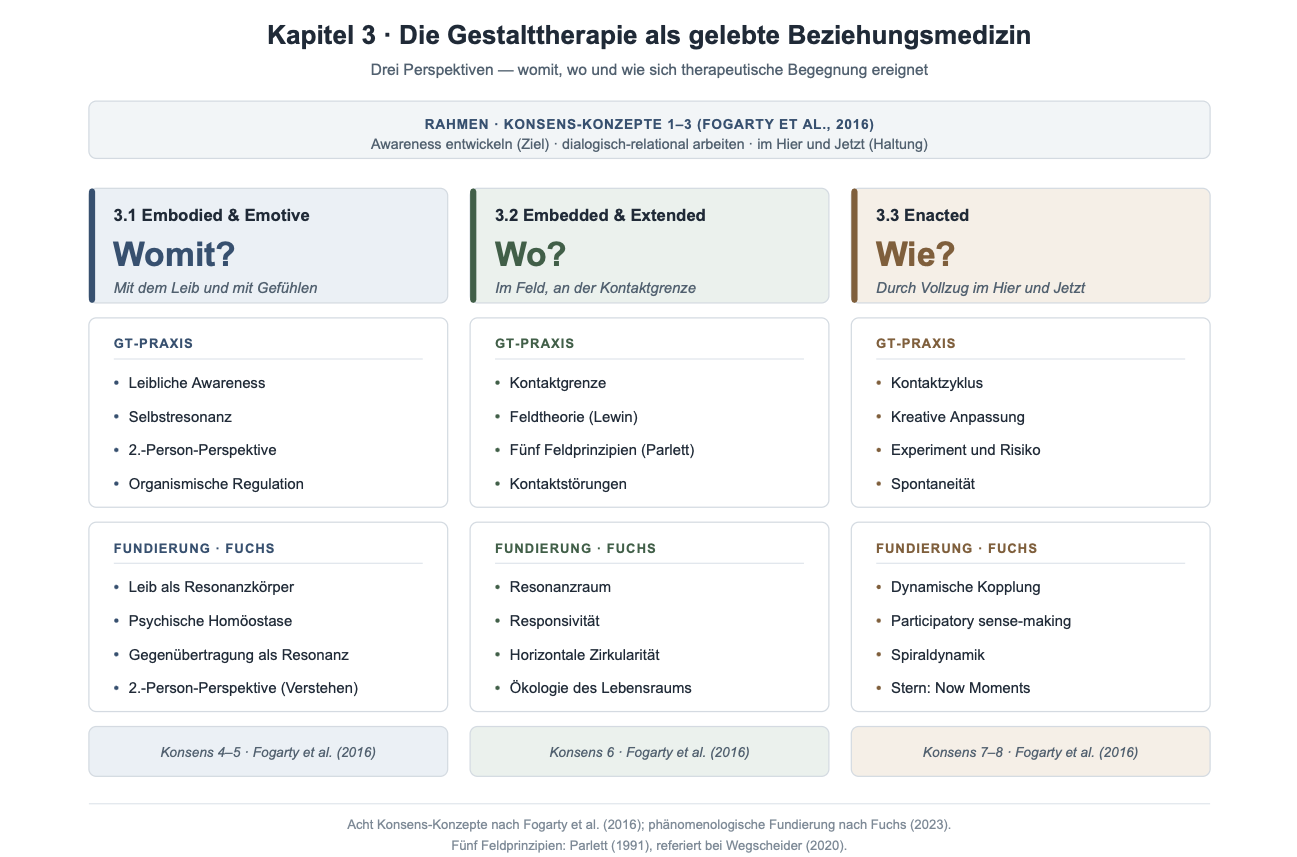
Figure 2: Structure of the third chapter: the three perspectives of Gestalt therapy as relational medicine.
Common to all three is a phenomenological approach. In a psychotherapeutic sense, this means ‘a focus on the bodily-personal experience of a specific person in a present moment of psychotherapeutic encounter’ (Fuchs & Schmidsberger, 2024, p. 113). Gestalt therapy is therefore defined not by content or technique, but by the therapist’s relational and bodily engagement at the boundary of contact, in the here and now. Fuchs and Schmidsberger (2024, p. 113) distinguish this psychotherapeutic meaning from two others: the philosophical, as a systematic science of subjective experience, and the psychiatric-diagnostic, as a descriptive classification of symptoms. Gestalt therapy utilises the psychotherapeutic approach, underpinned by the philosophical one, and distinguishes itself from the diagnostic approach. Its phenomenology is thus a participatory one, not one of detached observation. (Fuchs & Schmidsberger, 2024, p. 114) The consensus panel led by Fogarty independently confirms this approach and describes it as bodily-sensory (Fogarty et al., 2016, p. 37). Zinker refers to it as ‘experience anchored in the senses’ (2005, p. 89, cited in Fuchs & Schmidsberger, 2024, p. 113). It requires setting aside one’s own theories and expectations at the outset. Only this setting aside of preconceptions creates the openness and attentiveness that make perception in the present moment possible (Fuchs & Schmidsberger, 2024, pp. 113–114).
Stemming from this same openness, dialogical work requires the therapist to be willing to remain open-ended. Votsmeier-Röhr and Wulf (2024, p. 61) describe what this entails in practice: questioning and ‘setting aside’ one’s own expectations and preconceptions about the other person, and allowing for the ‘utterly unfamiliar’ and the unexpected, so as to be open to being surprised time and again throughout the course of therapy. The process is facilitated without a preconceived agenda and without the urge to change the client (Fogarty et al., 2016, p. 36). Within this indeterminacy, the therapist responds to the ‘unavailability’ defined in Chapter 2.2 as an essential aspect of genuine encounter: that which cannot be brought about can only be kept open.
We now turn our attention to the first of these three perspectives, the ’with what’: physical and emotional awareness.
3.1 Embodied & Emotive: Awareness and bodily self-resonance
In Gestalt therapy, ever since Perls, Hefferline and Goodman (1951/2019), ‘awareness’ has not meant reflecting on oneself, but rather the alert, bodily anchored …
3.2 Embedded & Extended: The Contact Boundary and the Field
Gestalt therapy breaks with the idea of an isolated inner space in which the ‘psyche’ takes place. In its place, Perls, Hefferline and Goodman (1951/2019) propose the …
3.3 Enacted: Presence in the Here and Now
The phenomenological tradition classifies human experience into a series of basic forms: self-experience, corporeality, spatiality, temporality, intersubjectiv ity and …