2.3 Inter-corporeality and intersubjectivity: the bodily realisation of the encounter (as the core of the therapeutic relationship)
In classical cognitive science, understanding is nothing other than information processing in the brain: the brain is regarded as a kind of computer that processes data and creates internal representations of the external world. The concept developed by Varela, Thompson and Rosch in 1991 (cf. Fuchs, 2023, p. 35) breaks with this perspective and places the living, acting organism at the centre.
“Cognition is not the representation of a given world by a given consciousness, but rather the creation of a world and a consciousness […].” (Varela, Thompson & Rosch, 1992, p. 15, abridged)
Varela’s research approach is known as enactivism (embodied and enactive cognition). The world is not represented by internal mechanisms, but is understood, in the truest sense of the word, through active, embodied action. Cognition is therefore not a process that takes place exclusively in the mind; rather, it arises from the constant and dynamic interplay between the brain, the body and the environment. In this view, the brain is not a representational apparatus, but rather an organ of relationship and resonance that mediates the body’s interactions with its environment (Fuchs, 2025a).
Thomas Fuchs applies this approach to social cognition, that is, to the question of how one person understands another. His answer is: not through internal simulation. The client is not ‘simulated’ in the therapist’s mind and evaluated there. Understanding occurs between the two, through bodily interaction in which both participate and which neither produces alone (Fuchs, 2023, p. 108). Fuchs therefore sees enactivism as a ‘promising basis for a new paradigm in psychiatry’ (Fuchs, 2023, p. 35). Humans are organisms interwoven with their environment, not information machines. (Fuchs, 2023, pp. 37–38).
This bodily embeddedness is not a discovery of contemporary cognitive research. The phenomenological tradition described it long before. Conscious experience is described in phenomenology as an active ‘being-in-the-world’ (Merleau-Ponty, cited in Bermes, 1998, pp. 70–77) mediated by the sensing body. In this model, personal experiences have an effect on the world itself and are not merely side-effects of brain processes. Merleau-Ponty distinguishes between two ways in which a person experiences themselves. As a body, they are a measurable, treatable object viewed from the outside. As a physical body, they are the lived body: that through which a person perceives, moves and encounters the world in the first place. A person has a body, but they are their ‘Leib’. Only a ’Leib’ can be affected and respond. An object cannot do this (Merleau-Ponty, cited in Bermes, 1998, pp. 70–77; cf. Fuchs, 2023, p. 107). Merleau-Ponty does not conceive of the body as an object amongst objects, but instead coins the term ‘intercorporeality’ (Zwischenleiblichkeit) to describe this reciprocal bodily relationship: the smile of the other is not registered as a muscle contraction and interpreted retrospectively, but is immediately and bodily shared as an expression.
Human experience is always simultaneously embodied, that is, bound to the living organism (the body). It is enactive, arising in action through constant interaction with the environment. It is extended beyond the body’s boundaries into space, tools and other people, and embedded in a concrete context. And it is grounded in affect (emotion), driven by motives and emotions. These five dimensions do not operate sequentially, but always simultaneously, and are referred to as 5E cognition as an extension of the 4E approaches.
In his paradigm of psychiatry as relational medicine, Fuchs draws the following clinical conclusion: healing is not the repair of an isolated brain, but rather the influence exerted on the overall ecological and bodily system of two people in contact (Fuchs, 2023) . What this influence concretely means in the therapy room is demonstrated by the bodily realisation of the encounter.
According to Fuchs, encounters with other people are based on reciprocity . This reciprocity does not manifest itself exclusively at the linguistic level:
“[…] underpinned by pre-reflexive – that is, non-focally conscious – processes of non-verbal interaction, which can also be described using a term coined by Merleau-Ponty (2003) as ‘intercorporeality’.” (Fuchs, 2023, p. 107, abridged)
According to Fuchs (2023, p. 107), when two people meet, an overarching system emerges that is characterised by ‘intercorporeality’. Through non-verbal channels such as facial expressions, gestures, eye contact or voice, the participants enter into a dynamic interplay. Fuchs illustrates this reciprocal ’incorporation’ using the example of a dancing couple: one’s own bodily sensations expand and integrate the other’s impulses, thereby creating a shared, inter-corporeal experience.
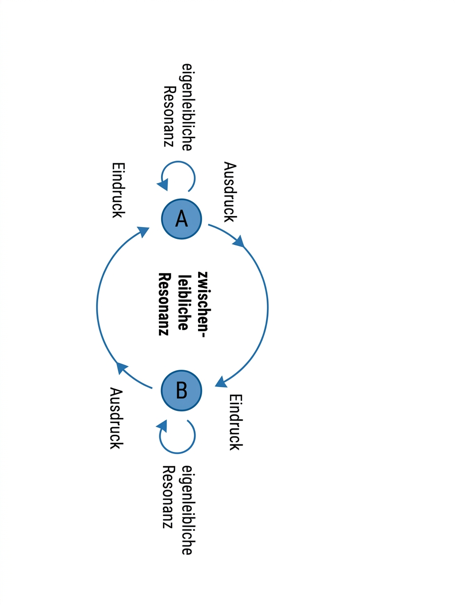
For Fuchs (2023, p. 112), emotions are not purely internal states, but interactive processes. In an encounter, the ‘circles of feeling’ of those involved intertwine: one person’s bodily expression (e.g. anger) is immediately translated into a bodily-emotional impression in the other person (such as tension), and this reaction in turn becomes an expression for the first person at that very moment. An unconscious, circular process of resonance emerges, in which emotion and affect continuously, in fractions of a second, mutually modify one another (interaffectivity, see Figure 1).
An affect—being moved by the client’s suffering—is thus always a co-affect. In the encounter, one’s own body functions as a sensitive resonating surface: therapists recognise the affective distress, tension or hesitation not only cognitively, but experience it directly as a bodily resonance, even before a word is spoken.
‘A dynamic interplay emerges, an inter-bodily resonance that also underlies empathy with the other.’ (Fuchs, 2023, p. 111)
This physical resonance presupposes a history of experience that every person brings to the encounter. This history begins long before the first word is spoken. Even in the first year of life, mother and child attune to one another. Daniel Stern calls this ’affect attunement’. No signs or symbols are exchanged in this process: the mother picks up on the intensity of the child’s emotional response, the rhythm in which it unfolds and how long it lasts, and responds to it with her own expression (Stern, 1993, pp. 203, 218, cited in Schorn, 2020, p. 44). This pre-linguistic attunement is the origin of intersubjectivity (Schorn, 2020, p. 44). Stern, to whom Fuchs also refers (Fuchs, 2023, p. 178), speaks of implicit relational knowledge: ’ ’ The deepest knowledge of how a person relates to others is proceduralFootnote 1 Procedural knowledge is the knowledge of how to do something, as opposed to declarative knowledge, which states that something is a certain way. Declarative knowledge can be articulated and passed on; procedural knowledge lies in the act of doing. Cycling, swimming, playing an instrument: no one can learn these through description alone, and those who can do them are usually unable to explain them. Relational knowledge is procedural in this sense — how close a person steps, how long they wait before replying, when they look away. It is acquired through lived experience, and it changes only through new lived experience, not by talking about it. and pre-verbal, non-verbal, non-symbolic and not consciously reflected upon (Stern, 2006, p. 28; Stern, 2005, p. 123). It encompasses affects, expectations, fluctuations in arousal and motivation, as well as thinking styles (Stern, 2005, p. 127; Stern, 2006, p. 28).
The psychotherapeutic process can be divided into two levels: alongside the explicit, content-related level, there is an implicit level. Here, the focus is not on what is said verbally, but on how the client and therapist interact with one another. According to Stern (2006, p. 28), this implicit knowledge also forms the basis for transference and countertransference. The regulation of the intersubjective field takes place, for the most par , implicitly, non-verbally and unconsciously (Stern, 2005, p. 129). Stern describes what happens at this implicit level as ‘the intersubjective search for one another, and the continuous expansion of the intersubjective common ground between two people’ (Stern, 2006, p. 32). Two people draw closer to one another, and through ‘improvising together’ (Stern, 2006, p. 33), something shared continually emerges. For this process of co-creation, Stern uses the term ’moving along’.
Because much remains unspoken at this level, a margin for manoeuvre emerges: missteps are possible without jeopardising the relationship. Stern notes that in implicit communication, mistakes are permitted and serve as an opportunity for a creative course correction, as a way of finding a path to being together (Stern, 2006, p. 33). The rupture and its repair are thus part of relationship-building, not its failure.
Similarly, Margherita Spagnuolo Lobb (2006, p. 51) describes the shaping of a relationship as a shared dance: ‘We can view every session, indeed the whole of therapy, as a dance.’
It is within this implicit field that the decisive turning points occur. Stern calls them ’Now Moments’: sudden moments of heightened affective tension that shake the familiar relational context and demand an authentic, unpredictable response from both parties (Stern, 2023, pp. 158–166). If such a moment leads to a genuine encounter, a ’moment of meeting’ arises, and within it the implicit relational knowledge of both parties changes permanently. It is precisely here, not in verbal interpretation, that the actual therapeutic change lies.
Therapeutic practice has a common name for this bodily resonance: empathy. According to Fuchs, empathy is underpinned by intersubjectivity (Fuchs, 2023, p. 111).
In traditional cognitive science, empathy is often understood as a rational adoption of another’s perspective or as intellectual mind-reading in the sense of a ’theory of mind’. From a embodied phenomenological perspective, this purely cognitive-functional definition falls short. In *Embodied Feelings*, Fuchs (2024a, p. 146) deconstructs the mechanistic understanding of empathy and distinguishes three inseparably linked stages that build upon intersubjectivity.
The first and most fundamental level is primary empathy: the involuntary, bodily resonance with the other. The facial and gestural expressions of the other person are replicated at a micromotor level within one’s own organism (motor mimicry). This gives rise to the ‘circle of emotion’ as described above. Anyone sitting opposite a person who is talking about a loss feels a tightness in their own chest before they know what it is about. Nothing is understood here; it is simply felt.
Extended empathy is built upon this foundation: the conscious imagination of what it is like to be in that person’s life situation. The therapist places themselves within the other person’s biographical world. This stage can become detached from the physical resonance. In that case, it remains a technique. Anyone who knows another’s pain without being affected by it can name it, offer comfort, or even interpret it accurately. They can just as easily exploit it. Only when knowledge of the pain is grounded in the body does it become understanding (Fuchs, 2024a, p. 155).
The third stage is iterative empathy: mutual awareness. ‘I feel that you are feeling with me, and you feel that I sense this.’ Both know from the other that they are reaching one another, and this knowledge intensifies as it happens. In this, the client experiences being held and meant by the other. The process requires vulnerability on both sides and remains beyond our control: what arises between two people cannot be controlled by either of them (Fuchs, 2024a, p. 160).
The three stages cannot be separated from one another. Iterated empathy cannot come about at all without bodily resonance. A response based solely on extended empathy may be apt; it may offer comfort; it may also be manipulative. What it cannot do is engage in a bodily encounter. It is precisely here that the limit lies, where ’ ’ stands as a disembodied, purely syntactic system: since primary empathy is not possible due to the lack of bodily presence, it remains merely a description from the outside.
With the paradigm of psychiatry as relational medicine, Fuchs provides the theoretical foundation for healing through relationships. The following chapter shows how Integrative Gestalt Therapy puts this paradigm into practice: as lived relational medicine.