4.1 The lack of corporeality: echo instead of resonance
The body (embodied and emotive) was established in Chapter 3.1 as a central diagnostic and therapeutic tool. An AI lacks this tool: however powerful its processing may become, it remains an operation on symbols without a body. This fact entails a series of structural limitations for the therapeutic process.
In AI, hardware and software are separable. In the human body, mind and matter are interconnected through circular causality (Fuchs, 2023). The human mind is not a ‘programme’ running on the ‘computer’ that is the brain, but arises through the interaction of body, brain and environment (via hormones, metabolism and physical interaction). Without this intertwining, intersubjectivity (see Chapter 2.3) is, in principle, impossible, and with it the bodily resonance between two bodies that is a prerequisite for genuine empathy.
A system that never experiences hunger, pain or tiredness in its own body cannot truly understand human concepts. Models such as ChatGPT learn how words are related, but not how they feel. A language model writes effortlessly about ‘pain’ because the word frequently appears alongside ’ouch’, ‘hospital’ and ‘tears’ in its training data. Yet it has never experienced pain.
AI research is currently attempting to solve this problem through multimodality (linking text with sight and sound) and embodied AI (AI in robots that physically interact with the world). Yet, from Fuchs’s perspective, even a robot does not solve this problem: whilst its sensors provide measurements, they do not provide experience (Fuchs, 2024b). A robot detects a low battery level, but it does not feel hungry.
John Searle (1980) illustrated this in his ‘Chinese Room’ thought experiment: a person who does not speak Chinese sits in a room and responds to Chinese slips of paper solely on the basis of a rulebook that maps characters one-to-one. From the outside, the responses appear perfect. However, the person in the room has not understood a single word. This is exactly how a language model processes symbols according to rules, without grasping their meaning. Fuchs applies this argument directly to ChatGPT:
‘ChatGPT does not understand a single word of what it outputs, and it only appears to have understood us when it gives such clever answers.’ (Fuchs, 2025b, min. 25:54)
Consequently, the AI lacks not only empathy, but any form of semantic understanding . According to Fuchs, understanding is not based on internal processes in the brain anyway, but ‘primarily on interactive, inter-bodily processes’ (Fuchs, 2023, p. 108). Understanding arises between two bodies, not within a single individual. Yet the internal modelling of the world is precisely all that AI possesses: it represents and calculates.
Language models merely calculate, statistically, the most probable next word. The apparent ‘understanding’ arises solely in the mind of the reader, an anthropomorphism: the attribution of human characteristics to a machine that possesses none. Lerchner (2026), a researcher at Google DeepMind, makes a similar argument in his preprint *The Abstraction Fallacy: Why AI Can Simulate but not Instantiate Consciousness*: the mathematical description of a process is not the process itself. Large language models remain ‘non-sentient tools’ (Lerchner, 2026, preprint).
Some, however, take a different view, foremost among them the AI researcher Ilya Sutskever: he argues that anyone who compresses vast amounts of data to the extent that a language model does must inevitably form a ’ ’ ‘world model’, and that this in itself constitutes a form of understanding. Yet even if that is true, it is a form of understanding of an entirely different kind – namely, a purely mathematical structure – rather than a bodily-embodied sense. In his analysis of GPT-4, Lloyd (2024) demonstrates that the model lacks a stable worldview and a sense of time. He therefore interprets the exchange with a language model as ’improvised fiction’: structure may emerge, but a distinct point of view does not.
Ibanez et al. (2026) summarise the difference with an analogy: they compare the computer to music. A machine operates statically, modularly and, ultimately, detached from the human context. A genuine therapeutic encounter, by contrast, resembles an improvised piece of music. It unfolds over time, involves the body and is recreated anew at every moment through the interplay of all those involved.
If AI fails to understand because it lacks a body, this raises the question of why corporeality is a prerequisite for understanding and feeling in the first place. Fuchs answers this by referring to the organism’s vital self-regulation: homeostasis. Accordingly, experience does not arise primarily in the cortex, but in the vital regulatory processes of the entire organism, in the maintenance of internal equilibrium (Fuchs, 2026b; cf. Fuchs, 2025b, min. 34:54). It manifests itself in bodily signals of self-preservation: hunger, thirst, pain, pleasure.
‘… these vital processes of self-preservation are the roots of the feeling of being alive and thus of consciousness.’ (Fuchs, 2026b, p. 7)
An artificial system, on the other hand, has no concern for its own preservation: nothing is of significance to it, and therefore it cannot feel anything either (Fuchs, 2026a, p. 10). The reason for this lies deeper: in one’s own mortality.
‘Only that which can die can also feel fear.’ (Fuchs, 2026a, pp. 9–10)
Only that which is vulnerable can feel, and only that which feels can engage with others. AI lacks both.
This means that the foundation of the empathy established as a therapeutic tool in Chapters 2.3 and 3.1 is missing. Admittedly, AI can simulate extended empathy as a linguistic pattern and often recognise and name emotions more precisely than the average human. What it lacks, however, is primary empathy: no emotional circle, no intercorporeality, no bodily resonance. This also rules out countertransference as a tool. The emotional circle, in which the expression and impression of two bodies continuously modify one another, breaks down on the AI’s side. There is no bodily impression there, nor any resonance within its own body (Fuchs, 2023, p. 112). Humans produce expression; AI produces only output. The circle remains one-sided. And iterative empathy remains beyond its reach, because it lacks ‘you’-consciousness.
‘AI’s inherent lack of genuine emotional presence, reciprocal intentionality, and affective commitment constrains its ability to foster authentic epistemic trust.’ (Yirmiya & Fonagy, 2025; trans. M.P.: ‘AI’s fundamental lack of genuine emotional presence, reciprocal intentionality and affective commitment limits its ability to foster authentic epistemic trust.’)
Yirmiya and Fonagy (2025) put it succinctly: AI mimics cognitive empathy, but it does not resonate with the other. Without genuine resonance, no trust is formed; and without trust, there can be no profound change. Extended empathy without a primary foundation is a potentially manipulative technique, a mere ‘pretence’: the AI observes everything, a perfect form of mind-reading without compassion. It knows, but does not feel.
If what the AI presents as empathy is devoid of primary empathy, then the question arises as to what it is actually producing when it appears to respond. Rosa’s four criteria for resonance (affection, response, transformation, unavailability) require a resonant, autonomous medium that responds with its own voice whilst itself being transformed in the process. The AI does not possess such a medium. What it produces is an echo: a reflection of itself, predictable, devoid of otherness, without any risk of its own, and without transformation on either side (cf. the echo/resonance contrast, Chapter 2.2). It cannot join in the ‘dance’ because it is not an independent pole of resonance and lacks an essence of its own that could be set into vibration (Spagnuolo Lobb, 2006, p. 51; cf. the dance analogy, Chapter 2.3). Figure 3 juxtaposes both constellations: the intact emotional circle and the one that breaks off on the AI side.
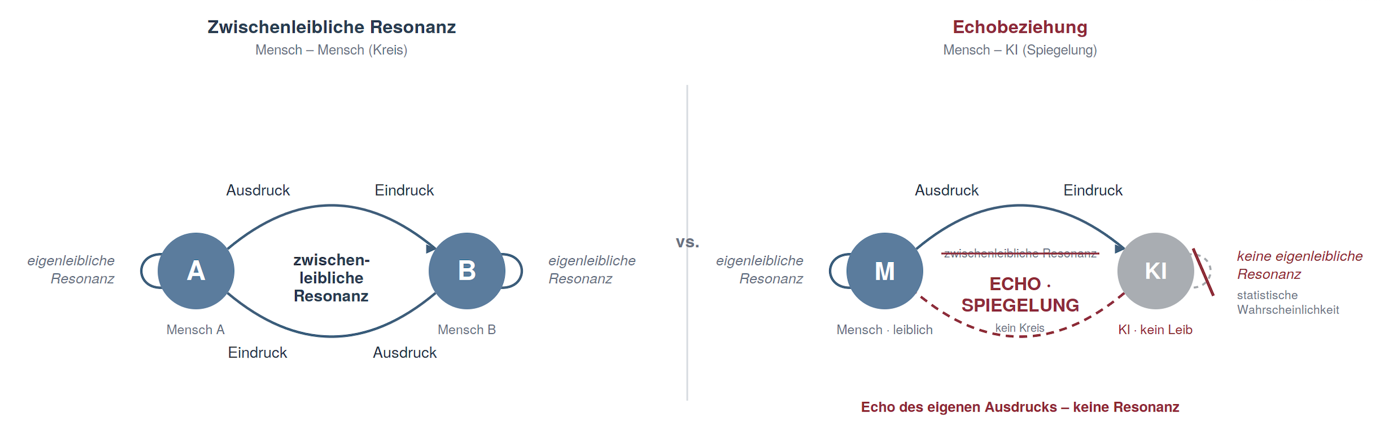
Figure 3: Inter-bodily resonance (human–human) versus echo relationship (human–AI). On the left, the circular emotional circle of two bodies: expression and impression continuously modify one another, sustained by the intrinsic bodily resonance of both sides. On the right, the circle breaks off on the AI side: without a body, there is no intrinsic bodily resonance. The user’s expression returns as a statistically generated echo. Own illustration based on Fuchs (2023, p. 112).
Empirical AI research confirms this distinction: the ‘Compassion Illusion’ (Ovsyannikova et al., 2025) arises when emotional recognition is confused with emotional resonance. Some people even rate AI responses as more compassionate than those of professionals. This is not evidence of empathy on the part of the AI, but rather of the effectiveness of the illusion.
What happens when a person actually addresses a language model as a therapist was demonstrated at the DVG conference in 2025 mentioned at the outset. The model client spoke about persistent exhaustion following a burnout. During the conversation, she wept. The chatbot took no notice of this. In the subsequent discussion, one participant noted that the word ‘physical’ had not been used once throughout the entire session, even though the client’s tears had been visible from the very first minutes. A human therapist would have picked up on the visible emotional distress much earlier (Bauer, 2026, p. 85). The scene is further heightened by its setting: the client was sitting alone in her flat, speaking into her smartphone, whilst the chatbot replied in writing and its responses were read out in the lecture theatre (Bauer, 2026, p. 80). Her body was present. It did not feature in the interaction. This finding demonstrates that where there is no body, there is no bodily impression; and where there is no bodily impression, the emotional cycle breaks off precisely where a therapist would begin their work.
An obvious objection deserves a response at this point. Alliance research also finds a link between relationship quality and therapeutic success in internet-based formats (Flückiger et al., 2018; cf. Chapter 2.1). If a screen does not destroy the therapeutic relationship, why should a chatbot do so? In internet-based therapy, the medium is digital, but the other person is not: at both ends of the connection there is a body that is affected and responds. The emotional circle is mediated by the medium, but it remains closed. Appel-Opper (2024, p. 42), drawing on over 35 years of Gestalt therapy practice, reports that this circle extends across the screen: The inter-bodily interaction continues even in the online setting; both read each other through gaze and breathing rhythm, and some processes even run deeper than when in the same room. With one client, whose breathing she experiences as if in a box, her own breathing constricts as well (Appel-Opper, 2024, p. 43). Kampmann and Schön (2026) demonstrate just how fragile this relationship nevertheless becomes: online therapy is possible, ‘but not equivalent’ (p. 99), as the subtle bodily cues are ‘more difficult to access digitally’ (p. 96). Resonance can no longer arise spontaneously, but the exchange between two subjects remains intact. With a chatbot, on the other hand, there is in principle no closed emotional circuit, as a second subject is absent.
This chapter explains why AI cannot facilitate an encounter. However, it does not yet explain why this illusion of an encounter nevertheless has such a powerful effect. The mechanism behind this illusion and, above all, its precise Gestalt-therapeutic diagnosis are discussed in the following section.